How to Measure ROI from AI in Engineering Teams
AI coding feels faster, but one study found developers 19% slower while feeling 20% faster. How to measure real AI ROI with DORA and SPACE.
Here is the most uncomfortable finding in software engineering right now. In a 2025 randomized controlled trial, METR gave experienced open-source developers AI coding tools and measured what happened. The developers expected to be 24% faster. After the experiment, they believed they had been 20% faster. They were actually 19% slower.
That gap—between how fast AI feels and how fast it actually delivers—is the single biggest reason engineering leaders are misjudging their AI investment. If your ROI case rests on "the team says it's a huge help," you are measuring a feeling, not a return.
This post is about measuring the return properly: what to count, what to ignore, and why the most common AI productivity metrics are the most misleading.
The Perception Gap Is Real (and Expensive)
The METR study is worth understanding because it was designed to be hard to dismiss. Sixteen experienced developers worked on 246 real tasks in mature codebases they already knew well—an average of five years of prior experience each. Tasks were randomly assigned: half allowed AI tools (mostly Cursor Pro with Claude), half didn't.
The result wasn't subtle. AI-assisted tasks took 19% longer. Yet every layer of perception pointed the other way—forecast, self-report, even gut feel after the fact all said "faster."
| Measure | Expectation | Reality |
|---|---|---|
| Developers' forecast | 24% faster | — |
| Developers' after-the-fact belief | 20% faster | — |
| Measured outcome | — | 19% slower |
But the lesson isn't "AI makes everyone slower." The lesson is: perceived productivity and real productivity are different variables, and AI inflates the first one hard. Any ROI process built on surveys alone will systematically overstate the gain.
Why Naive ROI Metrics Lie
When a vendor pitches an AI coding tool, the ROI math usually looks like this:
"Developers accept 30% of suggestions × 200 lines/day × team size × hourly rate = $X saved."
Every term in that equation is a trap.
1. Lines of code is an input, not an output
More code is not more value—it is more surface area to review, test, secure, and maintain. AI is exceptionally good at producing more code. That can actively hurt you. DX's Q1 2026 data found some organizations seeing up to 50% more defects after AI adoption. Code generated fast still has to be debugged slow.
2. Suggestion acceptance rate measures typing, not shipping
A 30% acceptance rate tells you developers pressed Tab. It says nothing about whether that code shipped, survived review, or had to be reworked next sprint. Acceptance rate is a vendor metric because it always looks good.
3. "Time saved" surveys measure the perception gap
We just covered this. Self-reported time savings are the exact number METR proved unreliable.
4. Speed without stability is a loan, not a gain
The 2025 DORA report found AI adoption is now linked to higher delivery throughput—a genuine reversal of 2024's gloomier finding. But it also confirmed AI has a negative relationship with delivery stability. Faster changes expose weak testing and review systems downstream. You can borrow speed today and repay it in incidents next quarter. This is the heart of why faster code generation doesn't automatically mean faster delivery: the bottleneck in most teams was never typing speed—it's review, testing, coordination, and integration, none of which AI autocomplete touches.
A Measurement Framework That Survives Scrutiny
Real ROI = (value of outcomes delivered − fully-loaded cost) ÷ fully-loaded cost. The hard part is measuring outcomes honestly. Use three layers.
Layer 1: DORA — does work actually reach users faster and safely?
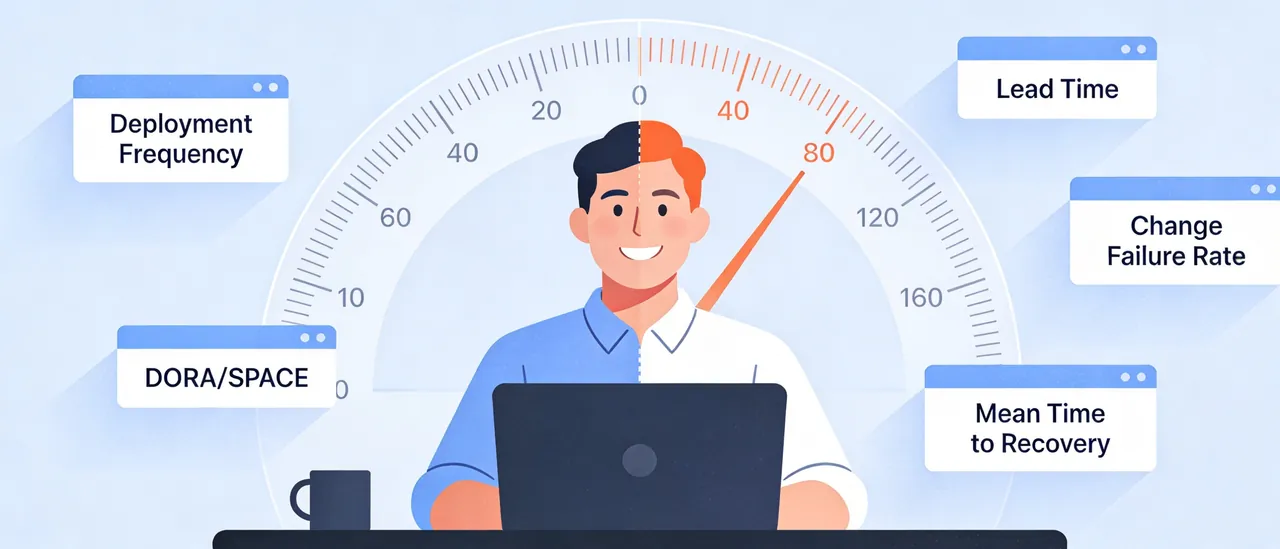
The four DORA metrics are the closest thing engineering has to a North Star, and they resist gaming because they measure flow end-to-end:
| Metric | What it catches that "lines of code" misses |
|---|---|
| Lead time for change | Whether AI speeds the whole path to production, not just typing |
| Deployment frequency | Whether throughput genuinely rose |
| Change failure rate | Whether speed came at the cost of quality |
| Time to restore | Whether you can recover when AI-assisted changes break |
Layer 2: SPACE — is this sustainable for humans?
The SPACE framework (Satisfaction, Performance, Activity, Communication, Efficiency) adds the dimensions DORA misses. AI can boost output while wrecking it: developers spending their day reviewing plausible-but-wrong AI code report higher cognitive load, not less. Track developer satisfaction and review burden alongside throughput.
Layer 3: Business outcomes — did it move a number that pays salaries?
Features shipped that customers use. Incidents avoided. Onboarding time for new hires. Support tickets deflected. This is the layer executives actually fund, and it's the one most AI ROI decks skip entirely.
How to Run the Measurement (So the Number Means Something)
Methodology decides whether your ROI figure is evidence or theater.
Track the same engineers over time, not team-vs-team. The most rigorous approach compares each engineer to their own pre-AI baseline. Cross-team comparisons drown in confounders—tenure, domain, seasonality. Same-person, before-and-after isolates the AI effect.
Allow a 3–6 month learning curve. Measuring in week two captures fumbling, not capability. Effective AI use is a skill (see Prompt Engineering in 2026); early numbers are noise.
Set a baseline before rollout. If you didn't capture DORA metrics pre-AI, your "after" number has nothing to compare against. Baseline first, then deploy.
Segment by task type. AI ROI is wildly uneven. Greenfield boilerplate, test scaffolding, and unfamiliar-API exploration: large gains. Deep changes in mature code you know well: the METR zone, often negative. Blended averages hide both.
Separate adoption from impact. "93% of developers use it" is an adoption stat, not an ROI stat. Adoption is necessary, not sufficient.
What Good Actually Looks Like
Strip away the vendor case studies claiming 55% gains and the picture sharpens. Across more grounded 2026 data, most organizations see 5–15% improvement in PR throughput—"real, but far below vendor claims." Teams with high adoption and mature engineering systems have pushed median PR cycle time down meaningfully (one dataset: ~24%, from 16.7 to 12.7 hours). Healthy ROI on AI coding tools lands around 2.5–3.5x for average teams and 4–6x for the top quartile.
Notice what separates the top quartile: not better tools—better systems. The 2025 DORA report's central finding is that AI amplifies the engineering system it operates in. Strong testing, clean version control, fast feedback loops, good documentation—AI multiplies those. Weak systems get their chaos amplified just as fast. The tool is a multiplier; your organization is the number being multiplied.
A Practical Scorecard
If you do one thing after reading this, replace your AI ROI survey with a scorecard like this, reviewed quarterly:
| Dimension | Metric | Healthy signal |
|---|---|---|
| Speed | Lead time for change | Down, sustained |
| Quality | Change failure rate | Flat or down (not up) |
| Throughput | Deploys/week, PR cycle time | Up without stability loss |
| Human | Developer satisfaction, review load | Up, or at least not worse |
| Business | Features adopted, incidents avoided | Tied to revenue/cost |
| Cost | Fully-loaded AI spend per engineer | Tracked, not assumed |
The Bottom Line
AI in engineering can absolutely deliver returns—the grounded numbers are positive, if modest. But the path runs directly through measurement discipline:
- Distrust the feeling. Perceived speed overstates real speed; that's now a documented effect, not a hunch.
- Never report velocity without quality. Speed that raises your change failure rate is debt.
- Measure outcomes, not activity. Lines, suggestions, and acceptance rates are vanity metrics.
- Compare engineers to their own baseline, over 3–6 months, segmented by task type.
- Fix the system, then add the multiplier. AI amplifies what you already have.
The teams winning with AI aren't the ones with the flashiest tools. They're the ones who can prove, with numbers that survive a skeptic, that the spend is paying off. Everyone else is paying for a feeling.
Next in this series: When AI Spend Becomes Waste—and how to build a cost-governance framework before it does.
Sources:
- METR, Measuring the Impact of Early-2025 AI on Experienced Open-Source Developer Productivity (July 2025) and Changing our Developer Productivity Experiment Design (Feb 2026)
- DORA, State of AI-Assisted Software Development 2025 (Google Cloud)
- DX, Q1 2026 engineering benchmarks
- Industry AI coding-tool ROI datasets, 2026
Related Reading:
Enjoying this article?
Get posts like this in your inbox. No spam, unsubscribe anytime.