The GitHub Commit Message Hall of Fame
Explore hilarious, brutal, and honest commit messages from developers worldwide. A celebration of code, chaos, and the raw truth behind the screen.
If you've spent any time in software development, you know the truth: commit messages are where developers speak their minds without a filter. They're the unguarded diary entries of the digital age—raw, honest, often hilarious, and sometimes deeply brutal. While pull requests are for the suits in meetings and documentation is for the masses, commit messages? That's where developers let loose.
This is the hall of fame of those moments. A celebration of the messages that make us laugh, cringe, relate, and occasionally question the mental health of our teammates. Because behind every "Fixed typo" is a developer who might have just battled a syntax error for six hours. Behind every "It works" is someone who has no idea why it works. And behind every cryptic "????" is a developer's existential crisis rendered in git history.
Let's dive into the glorious, chaotic world of commit messages that have become the folklore of software engineering.
The Classics: The Messages That Started It All
Some commit messages have achieved legendary status because they're relatable to literally every developer who's ever lived.
"Fixed it" - The most useless, most universal commit message in existence. It's technically a commit message. It follows the rules. But it tells you absolutely nothing. Did you fix a bug? A feature? A file? The universe? Your life? We'll never know. Yet somehow, this message has been written millions of times, and every time, a code reviewer sighs a little deeper.
"It works" - The sequel to "Fixed it," but with a question embedded in its simplicity. It works now, sure. But will it work tomorrow? Will it work in production? Will it work in a cold winter night when you're trying to deploy at 2 AM? The past participle "works" carries so much hope and so little certainty.
"Why?" - Sometimes a developer doesn't commit with a message so much as they commit with an unanswerable philosophical question. This is the developer staring at their code in disbelief, unable to comprehend the decisions their past self made. Future developers reading this will feel that same confusion.
"TODO" - The eternal optimist's message. "I'll come back to this later," the commit seems to whisper. Spoiler alert: you won't. That "TODO" has probably been in the codebase for three years now, a digital monument to good intentions.
These classics are so prevalent because they're born from a place of pure pragmatism (and desperation). When you're in a flow state, debugging for hours, or trying to ship before a deadline, the commit message feels like a formality. You're thinking about the code, not the narrative.
The Honest Ones: Admissions of Digital Chaos
Then there are the commit messages that are brutally, refreshingly honest. They're the confessions that make you feel less alone in this industry.
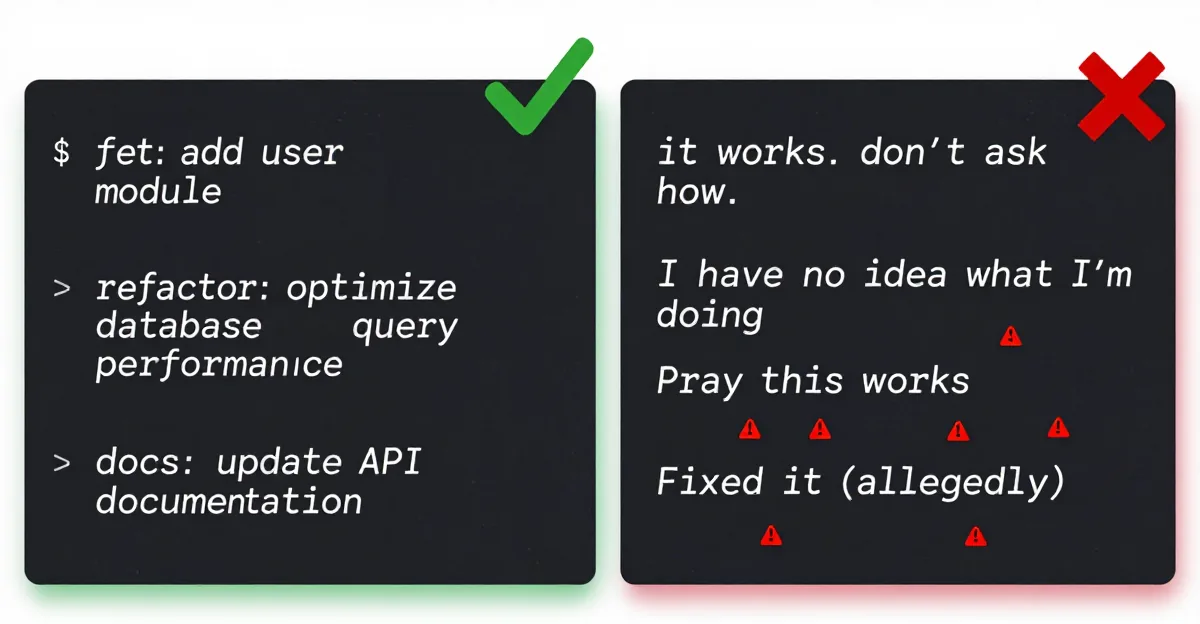
"I have no idea what I'm doing" - This one deserves a frame on every developer's wall. It's the admission that nobody has it all figured out. You're copying Stack Overflow, hoping the algorithm gods smile upon you, and just trying to make it to the next sprint. The developer who committed this message is probably the most self-aware person in the room.
"This code is a lie" - A developer wrote this when they realized their solution was a total hack, a band-aid on a bullet wound. But you know what? It works. It's in production. It's handling millions of requests. Sometimes the beautiful thing about software is that "wrong" and "working" are just different sides of the same coin.
"I will regret this" - A fortune teller with a text editor. Future self, I'm sorry for what you're about to inherit. This is the developer making a conscious choice to cut corners, knowing full well that they—or more likely, someone else—will pay for it later.
"Dark magic" - No explanation. No apologies. Just dark magic. This is for the code that shouldn't work, but does. The quantum mechanics of JavaScript where you don't look at it too hard or it breaks.
These messages are beautiful because they're real. They don't pretend that software engineering is a science. They acknowledge that it's often an art form, and sometimes that art form is abstract and confusing.
The Brutal Truth: Technical Debt Confessions
Some commit messages are modern cautionary tales about the cost of cutting corners.
"RIP performance, you will be missed" - A developer knowingly made the code slower to ship faster. It's a trade-off that happened in a meeting, without the developer's full consent, but they're owning it anyway.
"Prettier did this" - You know that moment when an auto-formatter ruins your carefully indented code? That moment when you want to blame someone but there's no one to blame? Enter Prettier. Except developers don't actually blame Prettier. They blame the decision to implement Prettier without proper configuration.
"This is the most inefficient algorithm ever written, but it works and I'm done here" - A developer reached their limit. They could optimize. They could refactor. But they're shipping. The debt is being collected.
"I literally have no idea why this works, and at this point, I'm afraid to change it" - The inverse problem. The code is doing something right, but nobody understands it. It's like a black box that produces gold, and you just... don't ask questions.
"If you're reading this, I'm sorry" - A developer from the past, reaching out to you in the future. They knew their code was bad. They were hoping that by the time someone had to maintain it, they'd be gone. (Spoiler: They weren't.)
These messages document the reality of software engineering: we make compromises. Every day. We sacrifice the perfect for the possible. We choose the pragmatic over the pure. And sometimes, we do it knowing it'll haunt us later.
The Desperate: 3 AM Messages and Prayer-Based Engineering
Some of the best commit messages come from developers in their darkest hours—literally and figuratively.
"FIXES #9999, allegedly" - It's 3 AM. There are 20 open issues. The QA team is breathing down your neck. You made a change that you think fixes it. You're committing it because you have to. Will it actually work? The "allegedly" suggests you have doubts.
"Pray this works" - There's no hope in this message. Just raw superstition. This is a developer who has exhausted logic and is now relying on the git gods.
"Please let this compile" - Same energy. Different desperation level.
"Please work please please please" - The capitalization is absent. The hope is gone. This is a developer in free fall, praying their parachute opens.
"It's 3 AM and I've run out of coffee" - A developer documenting their own decline in real-time. This is a cry for help disguised as a commit message.
"I don't know what I did, but it's working in production" - The miracle commit. The developer changed something, deployed it, and the monitoring dashboard turned green. They have no idea what they did. Do they investigate? Probably not. Do they backup and hope nobody ever asks them to do it again? Definitely.
These messages are the soundtrack to the software engineer's reality. Deadlines don't care about sleep. Features don't care about your mental health. And sometimes, you just ship something because you're out of time, out of coffee, and out of sanity.
The Passive Aggressive: Silent Developer Rage
Some commit messages are commit messages, and some are code comments disguised as commits.
"Fixed the bug that should never have existed" - The rage is subtle, but it's there. This is directed at whoever wrote the original code. Or maybe it's self-directed. Either way, there's a quiet fury in those words.
"Updated with the senior dev's 'brilliant' solution" - The quotes do the heavy lifting here. This developer got overruled in a code review and is documenting their disagreement for posterity.
"Removed debugging code that John left in" - Everyone in the office knows what this really means. John made a mistake. And now his mistake is immortalized in git history.
"Fixed what I said I would fix five commits ago" - This developer is holding themselves accountable, publicly, through commit messages. It's self-directed passive aggression.
"This shouldn't have needed a whole commit, but someone insisted on code review" - A dig at the company's culture, wrapped in sarcasm and commit messages.
These messages are the developer's way of building a case file. When something goes wrong, these commits are evidence. "I warned you," the git history whispers.
The Poetic: Developers as Digital Artists
Not all developers treat commit messages as administrative tasks. Some are artists, crafting messages that transcend the mundane.
"Refactored code with the grace of a drunken elephant" - This is self-aware humor meets brutal honesty. The code works, but it's inelegant. The developer knows it. And they're okay with it.
"The beautiful chaos of a runtime error turned into a feature" - A bug became something useful. A mistake became a feature. This developer chose to celebrate the accidental discovery.
"Tore down the walls and rebuilt the castle" - Poetic language for a major refactor. It's not just code changes; it's a reimagining.
"Painted the code with colors of hope and despair" - Pure poetry. This developer is treating code like art, acknowledging that it contains multitudes.
"Let the code speak for itself, because I'm tired of explaining" - A developer using the commit message to admit defeat. The code is what it is. Make of it what you will.
These messages remind us that software engineering isn't just logic and syntax. It's craft. It's creativity. It's human expression in a digital medium.
The Meta: Commits About Commits
Sometimes developers get recursive about commit messages themselves.
"Better commit message" - A developer commits a commit message fix. It's commits all the way down.
"Fixed the previous bad commit message by adding this better commit message explaining why the last one was bad" - The meta-comment about meta-comments. A message about messages about mistakes.
"Please forgive me for the last commit message" - A developer apologizing for their apology. Or maybe apologizing for being sarcastic in their previous apology.
"The commit message was longer than the actual code change" - A developer acknowledging that they spent more time explaining their fix than making it.
"This commit is about nothing, and yet it changes everything" - Pure Zen. This developer is playing 4D chess with git history.
These meta-messages are the developers' way of having fun with the system. They're breaking the fourth wall, acknowledging the absurdity of their own documentation.
The International: Lost in Translation Gems
When you're coding in a timezone where English isn't your first language, commit messages become an art form of accidental comedy.
"Fixing the stupid bug" - Translated from a developer's native language, this is actually quite endearing. The emotion is clear, even if the phrasing is direct.
"Code is like spaghetti, but it taste good" - A developer from somewhere warm and delicious decided to describe their code through the lens of Italian cuisine.
"Making the computer happy" - A poetic way to describe a bug fix, from a developer whose first language treats computers with more reverence.
"Sacrifice to the Java gods" - Across the world, developers know the pain of Java. This message bridges cultures through shared suffering.
"Cannot compile, so we dance" - A developer from a culture that accepts fate with grace decided to document their debugging process through interpretive metaphor.
"The app is broken, now it's unbroken, maybe" - The uncertainty translates beautifully across languages. This developer is speaking universal truth.
These messages are reminders that software engineering is global. And sometimes the best insights come from the friction between language and code.
The Lessons: What We Can Actually Learn
Beneath the humor and the chaos, there are real lessons in commit messages.
Write for humans, not machines. Your commit message will be read by humans. Lots of them. Maybe in six months when they're debugging a critical issue at 2 AM. Be kind to future them.
Be honest about trade-offs. Sometimes "good enough" is the right answer. But document it. Admit it. Future developers will understand that the world isn't perfect, and compromises were made with intention.
Leave a trail of breadcrumbs. Future you will want to understand past you's thinking. Even a sentence about why you chose this approach over that approach is gold.
Embrace the personality. Work doesn't have to be sterile. Your commit messages can have character. They should have character. You spend so much time with your code; let it reflect who you are.
Use conventional commit messages for the sake of automation and clarity. But within that structure, you can still be human. You can still be honest. You can still be funny.
Conclusion: The Unfiltered Truth of Code
Commit messages are the unfiltered voice of developers. They're the places where we admit our mistakes, celebrate our victories, and document our chaos. They're honest in a way that documentation never is and more permanent than a Slack message.
The commit message hall of fame isn't about the funniest or the cleverest. It's about the realest. It's about developers being human in a digital space. It's about the truth that lies beneath the polished presentations and the marketing speak.
So the next time you're writing a commit message at 3 AM, fueled by cold coffee and hot frustration, remember: you're not just documenting code. You're documenting a moment in time. You're leaving a message for your future self and your teammates. Make it count. Make it honest. And maybe, just maybe, make someone laugh.
Because in the end, that's what being a developer is all about. We're problem-solvers, artists, and sometimes accidental philosophers, all armed with a keyboard and an unbridled willingness to commit our thoughts to history.
And that, dear reader, is worth celebrating.
What's your favorite commit message? Share it in the comments below—the community loves a good confession.
Related Reading:
Enjoying this article?
Get posts like this in your inbox. No spam, unsubscribe anytime.