Grok vs Claude vs ChatGPT vs Gemini: Best AI for Developers
Grok vs Claude vs ChatGPT vs Gemini for developers: hands-on coding tests, India pricing and payments, plus the September 2026 models and API rates.
Editor's note (September 2026): This comparison was conducted October 2025 – January 2026, so the model versions named in the test sections are from that period. I have not re-tested the September 2026 models; anything said about them below comes from the vendors' own announcements, docs, and pricing pages. The hands-on verdicts still hold directionally; verify prices before subscribing. For choosing tools as a team rather than an individual, see how to measure AI ROI without fooling yourself.
Testing Period: October 2025 - January 2026 | Updated September 2026 — see editor's note above
Updated September 2026: what changed
> - New flagships. Anthropic released Claude Fable 5.1 on September 1 ($10/$50 per million input/output tokens). Its docs point most workloads to Claude Opus 5.5 ($4/$20). OpenAI announced GPT-6 Astra on September 3 ($10/$50), rolling out from Pro and Enterprise to Plus.
- Cheaper tiers moved too. Google launched Gemini 3.8 Flash on September 2 at an introductory $0.75/$3.75 that runs through December 31, 2026. xAI's Grok 4.7 arrived around September 20-21 at $2/$6 for prompts under 200K tokens.
- Context windows converged. Per vendor docs: GPT-6 Astra about 1.05M tokens, Claude Opus 5.5 and Fable 5.1 1M, Gemini 3.8 Flash about 1M, Grok 4.7 500K. Claude's 200K-context advantage from my testing period no longer exists.
- Unchanged: the hands-on verdicts below. They come from my original testing, not from tests of these new versions.
The AI assistant is no longer a novelty on your developer workstation. It is infrastructure. Like your IDE, terminal, and version control, your choice of AI assistant shapes how you think, code, debug, and learn every single day. And in 2026, that choice has become genuinely difficult.
Four frontier AI assistants now compete for the attention of developers worldwide: Grok from xAI, Claude from Anthropic, ChatGPT from OpenAI, and Gemini from Google. Each has evolved dramatically over the past year, each has distinct strengths, and each has passionate advocates claiming it is "the best."
For Indian developers specifically, this choice carries additional weight. Pricing in INR matters. Latency from Indian cities matters. Payment method availability matters. Whether a service works reliably without VPN workarounds matters. These India-specific factors often go unaddressed in global comparisons written from Silicon Valley perspectives.
This comparison is different. Over the past three months, I have used all four AI assistants daily across real development projects—debugging production issues at 2 AM, learning new frameworks, writing documentation, building automation agents, and everything in between. I tracked response quality, measured latency from Bangalore and Mumbai, tested payment flows with Indian cards, and documented every friction point and delight moment.
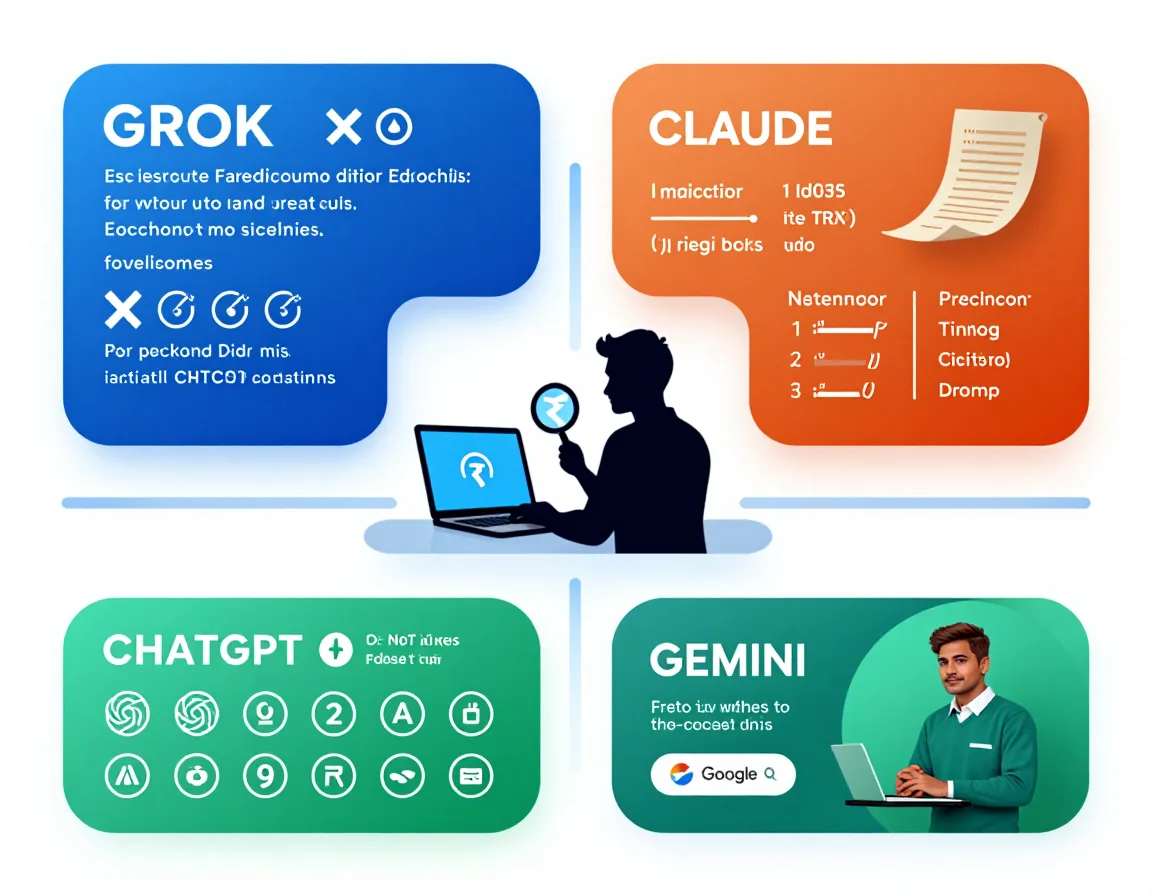
The short answer: For most developers, Claude is the best AI for coding and code review, ChatGPT is the most versatile daily driver, Gemini has some of the cheapest API rates and the friendliest free tier for India, and Grok is best for real-time information. As of September 2026 the current models are Claude Opus 5.5 and Fable 5.1, GPT-6 Astra, Gemini 3.8 Flash, and Grok 4.7. The coding verdict comes from my October 2025 – January 2026 testing, not from tests of these newer versions.
The quick verdict before we dive deep:
- Best for coding depth and code review: Claude
- Best for real-time information and research: Grok
- Best ecosystem and versatility: ChatGPT
- Best for Google-integrated workflows: Gemini
- Best free tier for Indian developers: Gemini
- Best value paid option: Claude Pro
But these one-line summaries hide nuances that matter. A developer building microservices in Go has different needs than one maintaining a legacy PHP codebase. A freelancer on a tight budget evaluates differently than someone whose employer pays for subscriptions. Let us examine each contender thoroughly, then match recommendations to specific situations.
The Contenders: Quick Overview
Before diving into detailed comparisons, let us understand what each AI assistant brought to the table during testing (October 2025 – January 2026); see the editor's note above for how the lineup has moved on since.
Grok (xAI)
Elon Musk's xAI launched Grok in late 2023, but 2025 transformed it from curiosity to serious contender. Grok 3, released in February 2025, demonstrated benchmark-topping reasoning capabilities. The December 2025 update added multimodal understanding, voice mode, and DeepSearch for autonomous research.
Defining characteristic: Real-time knowledge through X (Twitter) integration. While competitors rely on web search or training cutoffs, Grok has live access to the world's largest real-time information stream.
Current models: Grok 2 (free tier), Grok 3 (Premium/SuperGrok)
Pricing: Free tier available, Premium at $8/month via X Premium, SuperGrok at $30/month
Now (September 2026, per xAI): Grok 4.7 is xAI's recommended model for code and chat. It has a 500K-token context window and API pricing of $2 input / $6 output per million tokens below 200K prompt tokens.
Claude (Anthropic)
Claude has become the thinking developer's AI. Where ChatGPT optimizes for broad appeal, Claude optimizes for depth, nuance, and reliability. During my testing, Claude Sonnet 4.5 was the workhorse model, while Claude Opus 4.5 (released November 2025) pushed frontier reasoning with extended thinking.
Defining characteristic: 200,000-token context window and superior code understanding. Claude can analyze entire codebases, understand complex architectural patterns, and provide nuanced technical feedback.
Models at time of testing: Claude Sonnet 4.5 (free/Pro), Claude Opus 4.5 (Pro)
Pricing: Free tier available, Pro at $20/month
Now (September 2026, per Anthropic): Claude Opus 5.5 is the recommended default and Claude Fable 5.1 the top tier for long-horizon agentic work. Sonnet 5 is the faster mid-tier. All three have 1M-token context windows. Pro is still $20/month and includes Opus; Fable runs on usage credits.
ChatGPT (OpenAI)
ChatGPT remains the default AI assistant for millions—the household name that introduced the world to conversational AI. The GPT-4o model brought speed and multimodal capability, while o1 and o1-pro added extended reasoning for complex problems. The GPT Store ecosystem offers thousands of specialized assistants.
Defining characteristic: Largest ecosystem and most versatile capabilities. From custom GPTs to plugins to the broadest third-party integration support, ChatGPT offers the most comprehensive platform.
Current models: GPT-4o (free/Plus), o1 and o1-pro (Plus/Pro)
Pricing: Free tier available, Plus at $20/month, Pro at $200/month
Now (September 2026, per OpenAI): GPT-6 Astra is the flagship, with a 1.05M-token context window and API pricing of $10 input / $50 output per million tokens. It launched to Pro, Enterprise, and Business Premium users, with Plus access to follow. I could not verify current ChatGPT plan prices from OpenAI's own pricing page, so check before subscribing.
Gemini (Google)
Google's Gemini (rebranded from Bard) leverages the company's vast infrastructure and data. Gemini 2.0 (available during our testing period; since superseded) delivered on multimodal promises, and Deep Research can conduct autonomous multi-step research with citations. The 1-million-token context window (experimental) sets a scale benchmark.
Defining characteristic: Deep Google ecosystem integration. If you live in Google Workspace—Gmail, Docs, Drive, Calendar—Gemini weaves AI assistance into tools you already use.
Current models (at time of testing): Gemini 1.5 Flash (free), Gemini 2.0 (Advanced)
Pricing: Free tier available, Advanced at $20/month via Google One AI Premium
Now (September 2026, per Google): Gemini 3.8 Flash is the newest stable model, with a context window of about 1M tokens (1,048,576). Google calls it its best reasoning and coding model yet. Gemini 3.1 Pro is still listed as a preview in the API docs.
Head-to-Head Comparison by Use Case
Let us move beyond marketing claims and benchmark scores to what actually matters: how these assistants perform on real developer tasks.
A. Coding and Debugging
This is the core use case for most developers. I tested each assistant across code generation, bug finding, code explanation, refactoring, and multi-file context handling.
Code Generation Quality
For generating new code from requirements, Claude consistently produced the most production-ready output. Given a prompt to "create a rate limiter middleware for Express.js using Redis with sliding window algorithm," Claude's response included proper error handling, TypeScript types, configuration options, and inline comments explaining the algorithm—without being asked for any of these.
ChatGPT produced functional code but often required follow-up prompts for edge cases. Grok's code generation was competent but occasionally missed nuances in the requirements. Gemini performed well for straightforward tasks but struggled with complex algorithmic requirements. Learning good prompt engineering techniques helps get better results from all four.
Bug Finding and Fixing
I presented each assistant with production bugs from real codebases (with sensitive information redacted). Claude excelled at identifying subtle bugs—off-by-one errors, race conditions, memory leaks. Its explanations of why the bug occurred and how the fix addresses the root cause were consistently superior.
ChatGPT was strong at pattern-matching common bugs but occasionally missed context-dependent issues. Grok surprised me by catching a real-time data synchronization bug that others missed, likely due to its reasoning improvements. Gemini was adequate but rarely insightful.
Code Explanation
When asked to explain unfamiliar codebases, Claude's explanations were most useful for actually understanding the code. It would explain not just what the code does, but why it was likely written that way, what alternatives exist, and what to watch out for.
Refactoring Suggestions
Claude again led here, suggesting refactoring patterns that improved both readability and maintainability. Its suggestions aligned with established software engineering principles without being pedantic.
Multi-File Context Handling
This is where Claude's 200K context window shines. I uploaded 15 interconnected TypeScript files and asked for a comprehensive refactoring plan. Claude maintained coherent understanding across all files and suggested changes that respected dependencies. ChatGPT with GPT-4o handled 8-10 files reasonably. Grok and Gemini struggled beyond 5-6 files.
Winner for Coding: Claude
The combination of code quality, nuanced understanding, and massive context window makes Claude the clear winner for serious development work. The gap is most noticeable on complex, multi-file tasks.
Code Snippet Comparison
Here is how each assistant handled a request to "write a TypeScript function that debounces async functions with proper cancellation support":
Claude's response (abbreviated):
interface DebouncedAsyncFunction<T extends (...args: any[]) => Promise<any>> {
  (...args: Parameters<T>): Promise<ReturnType<T>>;
  cancel: () => void;
  flush: () => Promise<ReturnType<T> | undefined>;
}
export function debounceAsync<T extends (...args: any[]) => Promise<any>>(
  fn: T,
  delay: number
): DebouncedAsyncFunction<T> {
  let timeoutId: NodeJS.Timeout | null = null;
  let abortController: AbortController | null = null;
  let pendingPromise: Promise<ReturnType<T>> | null = null;
  let lastArgs: Parameters<T> | null = null;
const debouncedFn = (...args: Parameters<T>): Promise<ReturnType<T>> => {
    lastArgs = args;
// Cancel any pending execution
    if (abortController) {
      abortController.abort();
    }
if (timeoutId) {
      clearTimeout(timeoutId);
    }
abortController = new AbortController();
    const currentController = abortController;
pendingPromise = new Promise((resolve, reject) => {
      timeoutId = setTimeout(async () => {
        try {
          if (currentController.signal.aborted) {
            return;
          }
          const result = await fn(...args);
          if (!currentController.signal.aborted) {
            resolve(result);
          }
        } catch (error) {
          if (!currentController.signal.aborted) {
            reject(error);
          }
        }
      }, delay);
    });
return pendingPromise;
  };
debouncedFn.cancel = () => {
    if (timeoutId) clearTimeout(timeoutId);
    if (abortController) abortController.abort();
    timeoutId = null;
    abortController = null;
    pendingPromise = null;
  };
debouncedFn.flush = async () => {
    if (timeoutId && lastArgs) {
      clearTimeout(timeoutId);
      timeoutId = null;
      return fn(...lastArgs);
    }
    return pendingPromise ?? undefined;
  };
return debouncedFn as DebouncedAsyncFunction<T>;
}
Claude provided complete TypeScript types, proper AbortController integration, and utility methods (cancel, flush) without being asked. The code handles edge cases like calling cancel during execution.
ChatGPT's response was functional but lacked the AbortController integration and flush method. Grok and Gemini provided simpler implementations that would work for basic cases but miss production requirements.
B. Research and Learning
Developers constantly learn—new frameworks, unfamiliar APIs, evolving best practices. How well do these assistants support learning workflows?
Technical Documentation Queries
When asking about specific API details or framework behaviors, accuracy varies significantly. Grok with real-time access often provided the most current information, especially for rapidly evolving technologies. Claude's explanations were most thorough and educational. ChatGPT balanced currency and depth reasonably. Gemini's Deep Research feature excelled at synthesizing multiple sources.
Staying Current with New Libraries
For questions about libraries released in late 2025, Grok consistently had the most current information. When I asked about a new React Server Components pattern that emerged in November 2025, Grok knew about it while Claude and ChatGPT referenced older patterns (though both acknowledged their knowledge cutoffs when pressed).
Explaining Complex Concepts
Claude excels at making complex concepts accessible without oversimplifying. Its explanations of distributed systems concepts, algorithm complexity analysis, and architectural patterns were consistently the most useful for genuine understanding.
Source Citation Quality
Gemini Deep Research provides the most thorough citations, automatically generating a research report with numbered references. Grok cites X posts and web sources. ChatGPT's citations have improved but remain less consistent. Claude does not natively cite sources but acknowledges uncertainty clearly.
Winner for Research: Grok (for currency) / Claude (for depth)
A tie depending on your priority. Grok for staying current with rapidly evolving tech, Claude for deep understanding of established concepts.
C. Writing and Documentation
Developers write more than code—READMEs, API documentation, technical blog posts, architecture decision records, commit messages, and code comments.
Technical Writing Quality
Claude produces the most polished technical writing. Its documentation reads as if written by an experienced technical writer who also understands the code deeply. Sentence structure varies naturally, technical accuracy is high, and the tone matches professional documentation standards.
ChatGPT writes well but sometimes veers toward marketing-speak even in technical contexts. Grok's writing is direct and functional but occasionally too casual for formal documentation. Gemini produces adequate technical writing but rarely exceptional.
README Generation
I asked each assistant to generate a README for a medium-complexity open-source project. Claude's output required minimal editing—it included appropriate sections, clear installation instructions, and useful examples. ChatGPT's was good but included unnecessary flourishes. Grok's was concise, perhaps too concise. Gemini's was comprehensive but somewhat generic.
API Documentation
For generating API documentation from code, Claude understood the patterns and produced documentation that followed established conventions (JSDoc, OpenAPI-style descriptions). Its descriptions explained not just parameters but usage context.
Blog Post Assistance
For technical blog posts, Claude helps most with structure and argumentation while maintaining the author's voice. ChatGPT is strong at generating ideas and outlines. Grok adds timely context and examples. Gemini's Deep Research helps with background research.
Winner for Writing: Claude
Claude's writing quality is noticeably superior for technical contexts. The gap is most visible in nuanced documentation where precision matters.
D. Agent Building and Automation
The 2026 AI landscape is increasingly agentic—AI systems that can plan and execute multi-step tasks autonomously. How do these assistants support building and acting as agents?
Multi-Step Task Planning
I asked each assistant to plan a complex migration: "Plan the migration of a monolithic Node.js application to microservices, including identifying service boundaries, data migration strategy, and incremental rollout plan."
Claude's plan was the most thorough and practical, acknowledging trade-offs and potential pitfalls at each step. ChatGPT produced a comprehensive plan but with less nuance about real-world complications. Grok's plan was solid but briefer. Gemini's plan was structured but somewhat textbook.
Tool Use Capabilities
ChatGPT's function calling and GPT Actions are the most mature and widely integrated. Claude's Computer Use feature enables controlling desktop applications directly—powerful for automation scenarios that require GUI interaction. Grok's tool use is improving but less developed. Gemini integrates well with Google tools but less broadly.
Reliability for Autonomous Tasks
For tasks requiring minimal supervision, Claude's predictability and clear communication of uncertainty make it most trustworthy. It explicitly states when it is unsure rather than confabulating. ChatGPT occasionally exhibits overconfidence. Grok and Gemini vary in reliability.
API Quality for Integration
All four offer APIs, but ChatGPT's API ecosystem is most mature with extensive documentation, libraries, and community support. Claude's API is well-designed with excellent documentation. Grok's API is functional but newer. Gemini's API integrates well with Google Cloud but has fewer third-party integrations.
Winner for Agents: ChatGPT (ecosystem) / Claude (reliability)
ChatGPT for the ecosystem and integrations, Claude for reliability and predictability in autonomous operation.
E. Daily Productivity
Beyond specific tasks, which assistant is best for the thousand small interactions that comprise daily developer productivity?
Speed and Latency
From Indian locations (tested from Bangalore and Mumbai), latency varies:
- Gemini: Fastest responses, typically under 1 second for simple queries
- ChatGPT: Consistently fast, 1-2 seconds typical
- Claude: Slightly slower, 2-3 seconds typical, longer for complex reasoning
- Grok: Variable, 1-4 seconds depending on load
For quick lookups and simple questions, Gemini's speed advantage is noticeable.
Free Tier Generosity
Ranking from most to least generous for Indian developers:
- Gemini: Most generous free tier, substantial daily limits
- ChatGPT: Good free tier with GPT-4o access, reasonable limits
- Claude: Decent free tier but hits limits faster with heavy use
- Grok: Limited free queries (10/day), pushes toward Premium
Mobile App Quality
All four have mobile apps available in India:
- ChatGPT: Most polished mobile experience, voice mode works well
- Claude: Solid mobile app, good for reading and conversation
- Gemini: Well-integrated with Android, less polished on iOS
- Grok: Functional but less refined than competitors
Conversation Memory
ChatGPT's memory feature is most developed—it remembers preferences and context across conversations. Claude's Projects feature provides organized workspace memory. Gemini remembers within Google ecosystem context. Grok's memory is limited.
Winner for Daily Use: ChatGPT
The combination of speed, mobile experience, and memory makes ChatGPT the smoothest daily driver for general productivity.
India-Specific Factors
This section addresses factors rarely covered in global comparisons but critical for developers based in India.
Comparison Table
| Factor | Grok | Claude | ChatGPT | Gemini |
|---|---|---|---|---|
| Latency from India | Good (1-4s) | Moderate (2-3s) | Good (1-2s) | Excellent (<1s) |
| Free tier limits | Poor (10/day) | Moderate | Good | Excellent |
| INR pricing available | No | No | No | Yes (via Google One) |
| Data privacy stance | Moderate | Excellent | Good | Moderate |
| Works without VPN | Yes | Yes | Yes | Yes |
| UPI payment | No (needs card) | No (needs card) | No (needs card) | Yes |
| Indian card acceptance | Inconsistent | Good | Good | Excellent |
Network Latency Experiences
Testing from Bangalore (fiber connection, 100 Mbps):
Gemini consistently delivered the fastest responses, likely due to Google's extensive Indian infrastructure. Simple queries returned in under a second. This speed advantage compounds over hundreds of daily interactions.
ChatGPT performed well with consistent 1-2 second response times. OpenAI's infrastructure handles Indian traffic reliably.
Claude was slightly slower, typically 2-3 seconds, with complex reasoning requests taking longer. Not problematic but noticeable in rapid-fire coding sessions.
Grok showed the most variability, ranging from 1 second to 4+ seconds depending on server load. During peak US hours (which overlap with Indian evening), response times were slower.
Payment Method Availability
This is where Indian developers face real friction:
Gemini Advanced offers the smoothest payment experience. You can pay through Google One using UPI, which is available to virtually every Indian developer. No international card required.
ChatGPT Plus requires an international credit card. Many Indian credit cards work, but some users report declined transactions. Virtual international cards (through services like Fi or Jupiter) generally work.
Claude Pro accepts most Indian credit cards without issues in my testing. Visa and Mastercard both worked reliably.
Grok Premium (via X Premium) has been inconsistent. Some Indian cards work, others are declined. Paying through the Apple App Store or Google Play can bypass card issues but adds platform fees.
Data Residency Considerations
For developers working with client data or in regulated industries:
Claude has the strongest privacy stance. Anthropic does not train on conversations by default and offers clear data handling policies. For enterprise users, dedicated instances are available.
ChatGPT allows opting out of training data contribution. Enterprise tiers provide additional guarantees.
Gemini integrates with Google's broader data ecosystem, which may raise concerns for some enterprise contexts.
Grok data handling is less clearly documented, and the X integration means conversations may influence recommendations on the platform.
Service Reliability
All four services have been reliable from India without VPN requirements. However:
- During major outages (rare), Gemini typically recovers fastest due to Google's infrastructure
- ChatGPT has had occasional rate limiting during high-traffic periods
- Claude has been most consistently available in my experience
- Grok occasionally shows slower performance during US peak hours
Enterprise Adoption Considerations
For Indian enterprises evaluating these platforms:
Microsoft Copilot (based on OpenAI technology) may be easier to procure through existing Microsoft enterprise agreements, which many Indian companies already have.
Google Gemini can be procured through Google Workspace agreements, similarly common in Indian enterprises.
Claude and Grok require direct agreements, which may involve more procurement complexity.
Pricing Comparison
Subscription prices and the first five rows are as of January 2026 (testing period). The last two rows show API rates for each vendor's current headline model as of September 2026, taken from their own pricing pages. INR conversions at approximately Rs 84 per USD.
Plan Comparison Table
| Plan | Grok | Claude | ChatGPT | Gemini |
|---|---|---|---|---|
| Free tier | 10 queries/day (Grok 2) | Limited Sonnet access | GPT-4o with limits | Generous 1.5 Flash access |
| Basic paid | $8/mo (~Rs 672) via X Premium | $20/mo (~Rs 1,680) Pro | $20/mo (~Rs 1,680) Plus | $20/mo (~Rs 1,680) via Google One |
| Premium | $30/mo (~Rs 2,520) SuperGrok | Included in Pro | $200/mo (~Rs 16,800) Pro | Included in Advanced |
| API (input/1M tokens) | $2-5 | $3-15 | $2.50-15 | $0.075-7 |
| API (output/1M tokens) | $10-15 | $15-75 | $10-60 | $0.30-21 |
| Sep 2026 API, input/output per 1M | Grok 4.7: $2 / $6 (under 200K prompt) | Opus 5.5: $4 / $20; Fable 5.1: $10 / $50 | GPT-6 Astra: $10 / $50 | 3.8 Flash: $0.75 / $3.75 (intro, to Dec 31, 2026) |
| Sep 2026 context window | 500K | 1M | ~1.05M | ~1M |
Value Analysis for Indian Developers
Best value on a tight budget: Gemini Advanced
At Rs 1,680/month with UPI payment support, generous limits, and Deep Research included, Gemini Advanced offers the most accessible entry point for Indian developers who want paid AI capabilities.
Best value for serious development: Claude Pro
At the same Rs 1,680/month, Claude Pro provided superior coding assistance in my testing, long context for large codebases, and the most reliable output quality. If coding is your primary use case, Claude justifies the cost through productivity gains.
Best ecosystem value: ChatGPT Plus
For Rs 1,680/month, you get GPT-4o, access to the GPT Store, custom GPTs, and the broadest integration ecosystem. If you need versatility across coding, writing, and general tasks, ChatGPT Plus delivers.
Best for real-time needs: Grok Premium
At Rs 672/month (the cheapest paid option), Grok Premium offers unlimited Grok 2 and limited Grok 3 access. Excellent value if real-time information is your primary need.
When to pay for Pro/Premium tiers:
- ChatGPT Pro ($200/mo): Only if you need unlimited o1-pro access for complex reasoning tasks. Overkill for most developers.
- SuperGrok ($30/mo): If you heavily use DeepSearch for autonomous research or need unlimited Grok 3.
API Pricing for Building Applications
For Indian startups and developers building AI-powered products:
Gemini API is still one of the cheapest places to start for high-volume work. During testing, Gemini 1.5 Flash ran $0.075/1M input tokens. Today Gemini 3.8 Flash is $0.75 input / $3.75 output per million tokens, and Google's pricing page says that doubles to $1.50 / $7.50 on January 1, 2027. Budget for the higher rate.
Claude API offered the best quality-to-price ratio for coding and writing tasks in my testing, when Sonnet cost $3/1M input tokens. Per Anthropic's current pricing, Sonnet 5 is $2 / $10 and Opus 5.5 is $4 / $20 per million tokens.
OpenAI API has the most mature ecosystem and broadest model selection, making it the safe choice for production applications despite moderate pricing.
Grok API is competitive on price (Grok 4.7 at $2 / $6, per xAI), but the ecosystem is less developed, adding integration overhead.
The Verdict: My Recommendations
After three months of daily use across real projects, here are my recommendations for Indian developers.
Best Overall for Indian Developers: Claude Pro
For developers who primarily code and write technical content, Claude Pro at Rs 1,680/month delivers the highest productivity improvement. The combination of superior code understanding, massive context window, and excellent writing quality makes it the most valuable investment for serious development work.
The payment process works smoothly with Indian cards, latency is acceptable, and the output quality consistently reduces time spent on revisions and debugging.
Best for Specific Use Cases
Best for coding: Claude
In my testing, superior code understanding, long context, and nuanced explanations made Claude unmatched for serious development work. Whether debugging complex issues, refactoring legacy code, or learning new frameworks, Claude provides the most useful assistance. For hands-on coding, Claude Code takes this even further with autonomous codebase-wide operations.
Best for research: Grok
Real-time knowledge through X integration means Grok often knows about new library releases, security vulnerabilities, and industry developments before competitors. For staying current in fast-moving tech, Grok is invaluable.
Best for writing: Claude
Technical documentation, README files, blog posts, architecture documents—Claude consistently produces the most polished output requiring least editing.
Best free option: Gemini
The most generous free tier, fastest responses from India, and UPI payment when you want to upgrade. For developers on tight budgets or those evaluating options, Gemini is the obvious starting point.
Best value paid: Claude Pro or Gemini Advanced
Both at Rs 1,680/month, the choice depends on priorities. Claude for coding depth, Gemini for research breadth and Google integration.
Best for real-time information: Grok
No contest. The X integration and real-time knowledge give Grok a genuine advantage for current events, trending discussions, and recent developments.
My Personal Setup
I use multiple AI assistants daily, each for its strengths:
Primary coding assistant: Claude Pro
For code review, debugging, refactoring, and technical writing. I keep Claude open in a dedicated browser tab throughout my workday.
Real-time research: Grok
When I need current information—recent library updates, community discussions about new tech, breaking news in the developer ecosystem.
Quick lookups and general queries: ChatGPT
For rapid, general questions where I need fast answers rather than deep analysis. The mobile app is my go-to during commutes.
Google ecosystem integration: Gemini
For tasks involving Gmail, Docs, or when I need Deep Research with citations for content creation.
This multi-AI workflow costs approximately Rs 3,360/month (Claude Pro + implicit Grok access through X Premium I already pay for), which I consider excellent value for the productivity gains.
Quick Decision Flowchart
Use this decision tree to find your starting point:
If you primarily write code and need deep technical assistance:
- Start with Claude Pro. The coding capabilities justify the subscription.
If staying current with latest tech is critical:
- Start with Grok Premium. Real-time knowledge is its unique advantage.
If you are budget-constrained:
- Start with Gemini free tier, upgrade to Advanced when limits frustrate you. UPI payment makes it accessible.
If you need the broadest ecosystem and integrations:
- Start with ChatGPT Plus. The GPT Store and API ecosystem are unmatched.
If you work primarily in Google Workspace:
- Start with Gemini Advanced. The integration is seamless and valuable.
If you are building AI-powered products:
- Use multiple APIs. Gemini for cost-sensitive tasks, Claude for quality-critical tasks, OpenAI for the ecosystem.
If you are unsure what you need:
- Start with free tiers of all four. Use each for a week. Your preferences will become clear.
If your employer is paying:
- Recommend Claude Pro for individual developers, Microsoft Copilot for organizations with M365.
Conclusion
The AI assistant landscape in 2026 offers Indian developers genuine choice among excellent options. Unlike two years ago when ChatGPT dominated by default, today's decision requires actual thought about your specific needs, workflows, and constraints.
There is no single "best" AI assistant. Claude excels at coding and writing. Grok leads in real-time knowledge. ChatGPT offers the broadest ecosystem. Gemini provides the best Google integration and India-friendly payment options.
My recommendation: start with free tiers of all four. Spend a week with each as your primary assistant. Note which you reach for naturally, which frustrates you, which makes you more productive. Your workflow will reveal your preferences more clearly than any comparison article—including this one.
The multi-AI workflow is the future. Different tasks benefit from different assistants. The developers who thrive in 2026 will be those who learn to leverage the strengths of each rather than pledging allegiance to one.
Your AI assistant is now as fundamental as your text editor. Choose wisely, but also choose adaptably. The landscape will continue evolving, and the assistant that best serves you in January may not be the best choice in December.
Start experimenting. The productivity gains are real, and they compound daily.
Frequently Asked Questions
Which AI is best for Indian developers on a budget?
Gemini offers the most generous free tier and accepts UPI payments for upgrades, making it the most accessible option. Claude Pro provides the best value for paid users who primarily code.
Do these AI assistants work reliably from India without VPN?
Yes, all four work reliably from India without VPN requirements. Gemini has the lowest latency due to Google's Indian infrastructure.
Can I pay for Claude or ChatGPT subscriptions with Indian cards?
Yes, most Indian Visa and Mastercard credit cards work for both Claude Pro and ChatGPT Plus. Some users report occasional declined transactions; virtual international cards from fintech apps (Fi, Jupiter) provide reliable backup options.
Which AI is best for learning new programming languages or frameworks?
Claude for deep understanding and nuanced explanations. Grok for information about the latest frameworks and libraries. Use both together for optimal learning.
Should I use one AI assistant or multiple?
Multiple, if practical. Each has distinct strengths. A common pattern: Claude for coding, Grok for research, ChatGPT for quick queries and mobile use. If you can only choose one, Claude offers the best all-around value for developers.
How do these compare to GitHub Copilot or Cursor?
GitHub Copilot and Cursor are specialized coding assistants integrated into your IDE. Claude, ChatGPT, Grok, and Gemini are general-purpose AI assistants that happen to be good at coding. Many developers use both—Copilot/Cursor in the IDE for inline suggestions, plus a general assistant in the browser for explanations, planning, and complex refactoring.
Is my code safe when using these AI assistants?
Claude has the strongest privacy stance—Anthropic does not train on conversations by default. All four offer options to disable training on your data. For sensitive code, check each platform's data handling policies and consider enterprise tiers with contractual guarantees.
Which AI assistant is improving fastest?
All four are improving rapidly. In September 2026 alone, all four vendors shipped new models, and each claims state-of-the-art results on at least one coding or agentic benchmark. Benchmarks now differ by vendor, so compare them with care. OpenAI continues adding ecosystem features. Google is catching up on quality while leveraging infrastructure advantages.
Have questions about choosing an AI assistant for your specific development workflow? Share your experiences in the comments—the community's collective knowledge helps everyone make better decisions.
Related Reading:
Enjoying this article?
Get posts like this in your inbox. No spam, unsubscribe anytime.